Why Version Control Exists: The Pendrive Problem
Today, version control systems like Git are a basic requirement in software development. Every professional team relies on them. However, this was not always true.
In the early days of software development, developers used very simple ways to share and manage code. These approaches worked when only one person was writing code. But as soon as teams started growing, these methods began to fail. To understand why version control exists, we must first understand how developers worked before it and the problems they faced. This naturally leads us to what is known as the pendrive problem.
How Developers Worked Before Version Control
Before modern tools existed, developers shared code using pendrives, email attachments, shared folders, or by manually copying files between systems. Usually, there was a single main copy of the project. This copy was passed from one developer to another whenever someone needed to make changes.
At first glance, this approach looked simple and practical. But as soon as more than one developer became involved, serious problems started to appear.
The Pendrive Analogy in Software Development
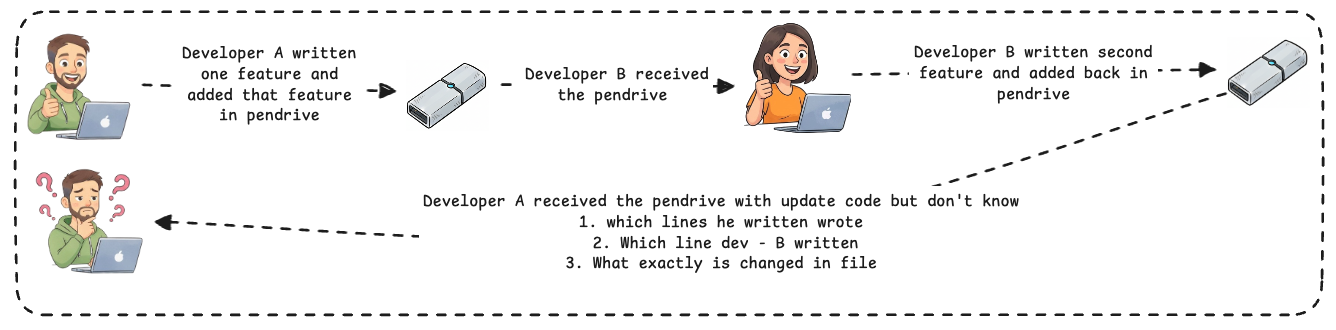
Imagine you are working on a software project and your friend is helping you build one feature. You copy your entire project onto a pendrive and give it to your friend.
Your friend adds a feature, saves the code, and returns the pendrive to you. You then copy that code back into your system and continue working.
At this point, several questions arise. You do not know which lines you wrote and which lines your friend wrote. You also do not know exactly what changed between versions. There is no record, no comparison, and no explanation. This confusion is what we call the pendrive problem.
Core Problems Before Version Control Systems
One of the biggest issues was the lack of change tracking. When code was shared through pendrives or emails, there was no record of what changed, who made the change, or when it was made. If a bug appeared, no one knew when it was introduced, why it happened, or who caused it. Debugging became slow and frustrating because there was no history to rely on.
Another major problem was overwriting code. If two developers worked at the same time, each worked on their own copy of the project. When both sent their versions back, one version overwrote the other. The last copied file automatically became the “latest” version, while the earlier work was lost permanently. There was no safe way to combine changes from multiple developers.

Because of this risk, real collaboration was almost impossible. Teams created strict rules such as “only one person works today,” “do not touch this file,” or “wait until I finish.” Only one developer could safely work at a time, which slowed down development and caused frustration.
To manage different versions, developers also started using confusing folder and file names like project_final, project_final_v2, project_final_latest, or even project_final_latest_really_final. These names had no real meaning. They did not explain what changed or which version was stable. Instead of clarity, they created more confusion.
Code loss was another serious issue. If a pendrive was lost, an email attachment was deleted, or a folder was overwritten by mistake, the code was gone forever. There was no backup, no restore option, and no history to recover from.
Why These Problems Grew With Team Size
As teams grew, these problems became worse. Two developers became five, then ten, and projects became larger and more complex. The pendrive and email-based approach could not scale. Teams started missing deadlines, releasing broken software, and dealing with constant instability. At this stage, a better system was no longer optional.
Why Version Control Exists
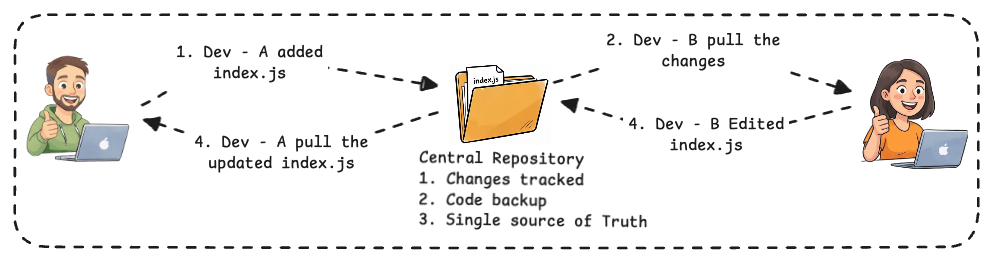
Version control systems were created to solve exactly these problems. They provide a complete history of changes, clear ownership of every update, safe collaboration between multiple developers, and the ability to go back to older versions of the code. They also act as reliable backups.
With version control, multiple developers can work at the same time, changes can be merged safely, and no work is lost.
Why Version Control Became Mandatory
Modern software development cannot function without version control. Without it, collaboration breaks down, code is lost, and development becomes chaotic. This is why every serious software team uses version control today.